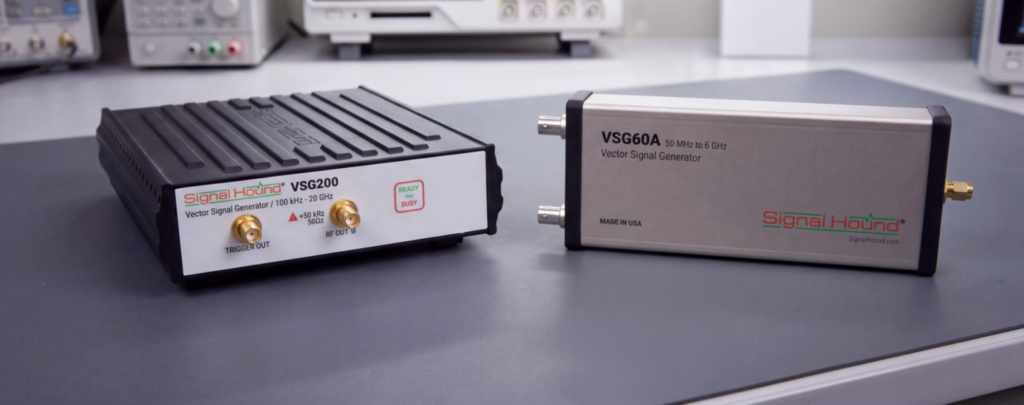
In the rapidly evolving world of Radio Frequency (RF) engineering, the ability to accurately simulate complex radar environments is no longer just a luxury, it is a necessity. Whether you are testing commercial radar transmitters, developing next-generation electronic warfare systems, or evaluating the resilience of sensitive receivers, the precision of your signal generation can make or break your project. Signal Hound has recently addressed this need head-on with the introduction of their new radar pulse generator for the VSG software, compatible with the VSG60 and VSG200 vector signal generators.
This update represents a significant leap forward for RF professionals who require high-fidelity simulation without the steep learning curve often associated with complex signal modeling. By combining an intuitive interface with deep technical control, Signal Hound is empowering engineers to create sophisticated radar pulse trains that mirror real-world conditions with unmatched accuracy. In this post, we will dive deep into the features of this new tool, exploring how it streamlines the workflow for radar simulation and testing.
Building Advanced Radar Sequences with the Sequence Editor
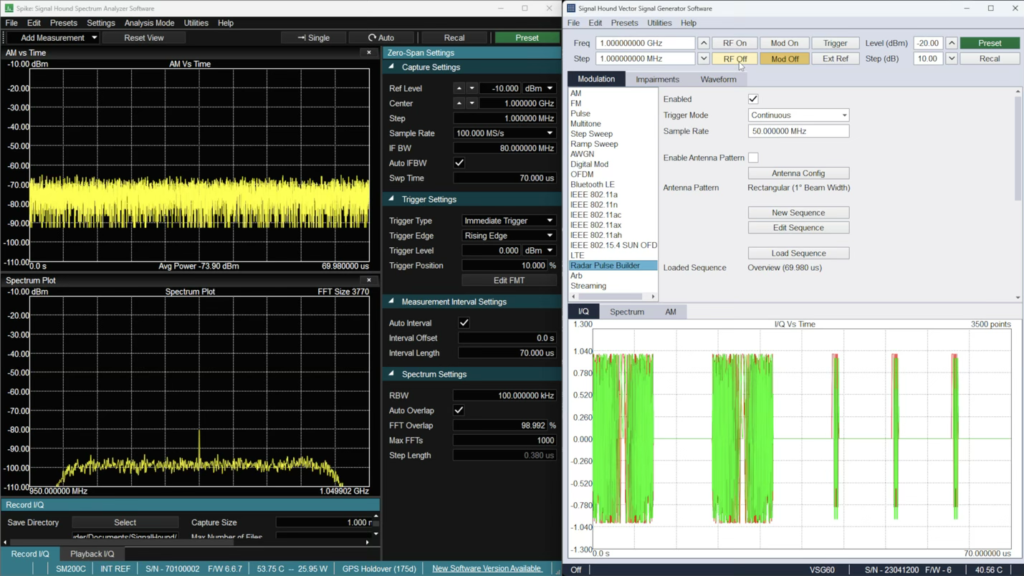
At the heart of the new software update is the Signal Hound Sequence Editor. This tool is designed to move away from rigid, one-size-fits-all signal generation. Instead, it allows users to build sophisticated radar sequences from the ground up. By utilizing a modular approach, engineers can combine individual pulses, predefined sequences, and specific off-time intervals to create a comprehensive “scenario.”
The flexibility of the Sequence Editor is one of its strongest selling points. Within the editor, you have granular control over several critical parameters for every element in your sequence, including:
- PRI Jitter: Simulate the Pulse Repetition Interval variations often used in radar to avoid jamming or interference.
- Lobulation: Control the amplitude variations to simulate antenna scanning effects.
- Scale and Phase: Adjust the magnitude and starting phase of individual pulses for coherent or non-coherent simulations.
- Frequency Offset: Apply specific frequency shifts to individual elements within the train to test receiver frequency agility.
One of the most practical features for a busy lab environment is the ability to edit, rearrange, or remove items with ease. Once a complex sequence is perfected, it can be saved for immediate transmission or stored as a building block for use in even more elaborate radar scenarios later.
Precision Pulse Shaping and Envelopes
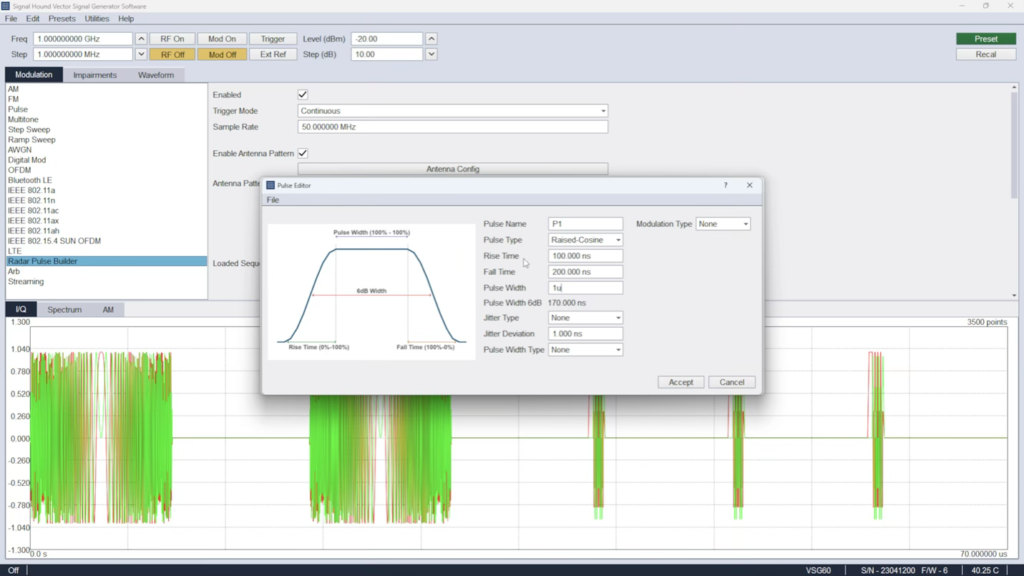
A radar pulse is rarely a perfect square wave in the real world. The “shape” of the pulse, its rise time, fall time, and overall envelope, carries significant spectral implications. Signal Hound’s radar pulse generator provides independent control over these parameters, allowing users to shape pulses using trapezoidal or raised cosine envelopes.
Customizing Pulse Profiles
The software offers independent control over the rise time, fall time, and pulse width. This is critical for engineers who need to manage the spectral regrowth of their signals or simulate specific hardware limitations of a transmitter. Additionally, the generator allows for the simulation of radars that vary their pulse width from one pulse to the next. This can be achieved through several methods:
- Linear Ramps: Gradually increasing or decreasing the pulse width over time.
- Stepped Patterns: Moving through a predefined set of pulse widths in distinct steps.
- Staggered Profiles: Creating fully customized, non-linear pulse width variations to mimic advanced electronic counter-countermeasure (ECCM) techniques.
Mastering Coded Waveforms and Modulation
Modern radar systems rely heavily on pulse compression to achieve high range resolution while maintaining high average power. To test these systems, you need a signal generator capable of producing complex, coded waveforms. Signal Hound’s VSG software now includes a robust suite of interpulse modulation options.
RF professionals can recreate the coded waveforms used by pulse compression radars with high precision. The available modulation types include:
- FM Chirp: Linear frequency modulation across the duration of the pulse.
- Barker Codes: Utilizing these well-known sequences for optimal autocorrelation properties.
- Frank Codes and Polyphase Codes: Support for advanced P1 through P4 polyphase codes, which are essential for modern digital radar simulation.
- Custom BPSK and QPSK: The ability to define custom Binary Phase Shift Keying or Quadrature Phase Shift Keying sequences for specialized applications.
By providing these options within a streamlined interface, Signal Hound eliminates the need for external mathematical modeling software to generate the raw data for these complex pulses.
Simulating Realistic Antenna Scans and Receiver Bearings
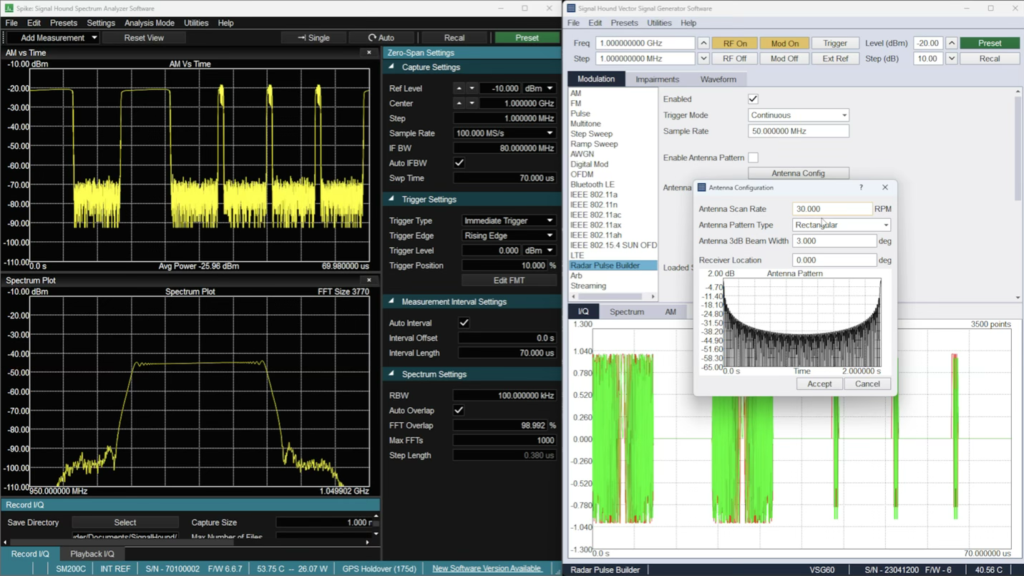
A radar signal doesn’t exist in a vacuum; it is transmitted through an antenna that is often moving. To provide a truly comprehensive simulation, the new pulse generator includes tools to simulate the spatial aspects of radar transmission. Users can configure the scan rate and beam width to see how the signal behaves as the radar rotates or scans its target area.
For those requiring even higher levels of realism, the software allows for the import of custom antenna gain patterns. By setting the receiver bearing, engineers can visualize the resulting signal level as the simulated beam sweeps across the receiver. This visualization is invaluable for evaluating how a receiver handles the dynamic range and timing of a scanning radar source.
Key Takeaways for RF Professionals
The integration of the radar pulse generator into the VSG software suite offers several actionable insights for engineers:
- Increased Efficiency: The intuitive GUI reduces the time spent on signal configuration, allowing more time for actual testing and analysis.
- Hardware Versatility: These advanced features are available for both the VSG60 and the VSG200, providing options for different budget and performance requirements.
- Enhanced Realism: By combining PRI jitter, custom pulse shaping, and antenna scan patterns, you can create a “digital twin” of almost any radar environment.
- Futureproofing: The ability to save sequences and use them as building blocks means your library of test cases can grow and evolve alongside your projects.
Conclusion
Signal Hound’s new radar pulse generator for the VSG software is a powerful addition to the tool kit of any RF professional. By bridging the gap between complex mathematical signal design and practical, hardware-driven generation, it provides a level of control that was previously difficult to achieve in such a streamlined package. From basic pulse trains to sophisticated, coded polyphase waveforms with custom antenna patterns, the precision radar simulation powered by Signal Hound is set to become an industry standard for testing and evaluation.
If you are looking to elevate your radar testing capabilities, it is time to explore what the VSG60 and VSG200 can do with this new software update. Whether you are in the lab or the field, precision and control are now right at your fingertips.
About the Author