The RF spectrum is becoming increasingly crowded with numerous types of wireless signals. These signals come from many different sources such as cellular networks, satellite networks, public safety networks, broadcasting services, and consumer wireless devices. In the United States, the Federal Communications Commission (FCC) and National Telecommunications and Information Administration (NTIA) are responsible for managing and licensing the spectrum, ensuring efficient and interference-free spectrum usage. These agencies establish rules and regulations for spectrum allocation, including specific technical standards for occupied bandwidth.
What is occupied bandwidth?
Occupied bandwidth (OBW) is a regulatory requirement that is specified for equipment in some global regions, including the United States and Japan*. It is originally defined by the Radiocommunication Sector of the International Telecommunication Union (ITU-R) as a maximum bandwidth, outside of which emissions do not exceed a certain percentage of the total emissions. Complying with this requirement ensures that signals do not leak outside of the specified frequency band which can cause interference and degrade communication and signal quality.
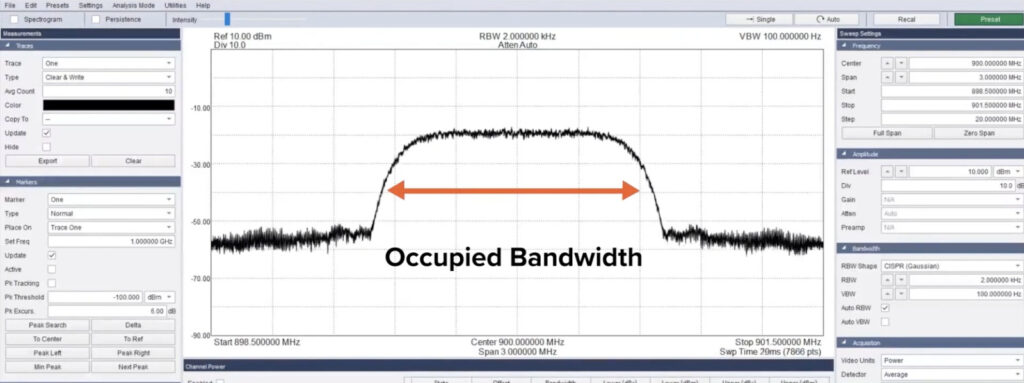
For any frequency or phase modulated signal, occupied bandwidth measurements are critical in ensuring that the transmission hardware and modulation parameters are properly designed to prevent interference and efficient transmission. For example, cellular technologies, Wi-Fi, and many more recent digital modulated technologies use a variety of modulation parameters, and some are even reprogrammable. Hence, ensuring that the OBW of the modulated transmissions stay within a specified bandwidth under all modulation configurations can help a designer make the necessary tradeoffs between hardware costs and data rate and bit-error-rate (BER).
How is occupied bandwidth measured?
Real-time spectrum analyzers (RTSAs) enable capture and record of real-time signals and can be used to illuminate important signal characteristics necessary in identifying and analyzing pulsed hardware and modulation schemes. OBW is one such measurement, where wide-bandwidth real-time signal capture of an entire pulsed signal and its transient behavior is necessary to make an accurate analysis of the transmitter and modulations signal characteristics.
There are several methods of measuring OBW. However, the general structure of the measurement concludes that OBW is the bandwidth of a signal in which 99% of the total integrated power of the transmitted spectrum is contained. The order of operations for the measurement is that first the total spectral power in the frequency range is measured.
Following this calculation and beginning at the lowest frequency range in the sweep, the power distribution at each frequency is summed until the summation reaches exactly 0.5% of the total spectral power within the sweep range. This measurement is repeated inversely starting at the highest frequency range and summing the power at each frequency until the sum reaches 0.5% of the total power. This method reveals the upper and lower frequency boundaries of the occupied bandwidth at the 0.5% points.
How can Signal Hound’s Spike software simplify OBW measurements?
Spike is Signal Hound’s spectrum analyzer software, compatible with the entire line of Signal Hound spectrum analyzers and signal generators. Providing full device control, a configurable spectrogram display, and a user interface with a variety of analysis modes, Spike is the perfect application for powerful and accurate RF analysis.
The occupied bandwidth feature in Spike measures the width of a frequency band such that, below the lower and above the upper frequency limits, the mean powers emitted are each equal to a specified percentage of the total mean transmitted power.
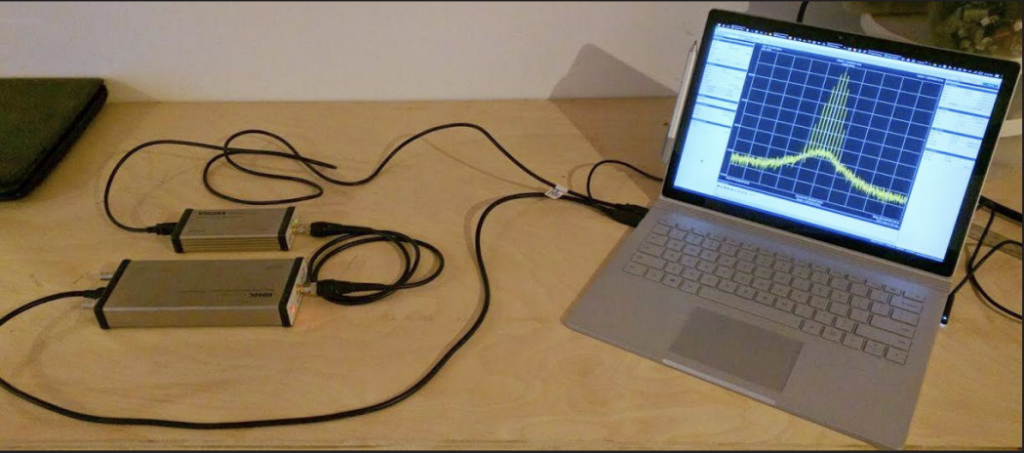
As coherent and noncoherent distortion effects can cause spectral regrowth and signal energy leaking into adjacent channels, the extremely broad bandwidth communications standards can be interfered with by even small amounts of signal energy leaking into the band. OBW, can be used to maintain standards of communication, quality, and diagnose degrading communications systems.
For example, a communication standard, 3GPP, may describe OBW as the bandwidth that contains 99.0% of the total integrated power of the signal, centered on the assigned channel frequency. Additionally, this bandwidth may be limited to a few megahertz, and any transmitter technology violating this requirement of the standard would fail compliance. An approximation of the center frequency can be achieved by finding the center point between the highest and lowest frequency of the occupied bandwidth.
The Occupied Bandwidth panel in Swept Analysis mode of Spike is used to measure the bandwidth containing a given percentage of the total integrated power of a transmitted signal. The percentage can be adjusted from 70 to 99%. Then, the center frequency of the sweep can be updated to reflect the measured center frequency of the signal with the click of a button.
Several tools exist within Spike to help identify and measure intermittent time-varying signals, such as a waterfall spectrum display (spectrogram), persistent display, max-hold, zero span mode, and more.
Conclusion
Signal Hound tools can be used to reliably produce OBW measurements rapidly and with little setup. For a full walkthrough of how to use Signal Hound equipment to make OBW measurements, please download our application note, Occupied Bandwidth and Channel Power Measurements with a Real-time Spectrum Analyzer.
Sources
- National Telecommunications and Information Administration, Who Regulates the Spectrum
- Science Direct, Occupied Bandwidth
About the Author